
Pillar: Agentic AI OSS
Governed Execution with Symphonica MCP
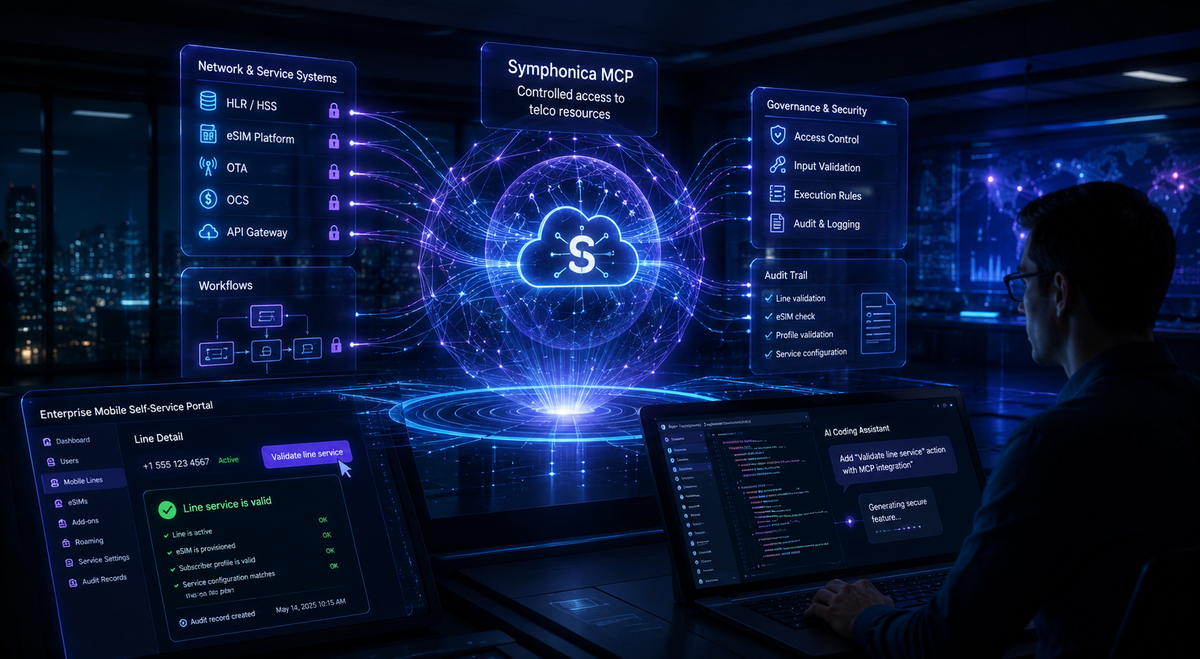
At DTW, Symphonica will show how telcos can use AI coding to move from business intent to governed, network-safe execution.
Telecom operators want to move faster. They need to launch new services, improve customer experiences, reduce development costs, and respond to business needs with greater agility.
AI-assisted coding can help. It allows teams to move from a requirement to working software faster, generating application logic, interfaces, and integrations with less manual effort.
But in telecom, faster development is only part of the story.
Every new application or workflow may eventually interact with sensitive network and IT systems. A portal action may need to validate a subscriber, check an eSIM profile, update a service configuration, query an inventory system, or trigger a network-facing process. Without the right controls, AI-generated code could introduce risk into environments where reliability, auditability, and operational safety are non-negotiable.
That is why the DTW demo focuses on a practical question: how can telcos use AI coding while keeping access to critical resources secure and governed?
From Business Intent to Governed Execution
The demo shows a multi-enterprise mobile management portal. Through this portal, an operator can serve several business customers from the same platform. Each enterprise administrator can manage mobile lines, eSIMs, users, roaming, add-ons, voicemail, call forwarding, network API subscriptions, and audit logs.
The use case begins with a simple business need. The operator wants to add a new action to the line detail page so an enterprise administrator can validate a selected mobile line and confirm that the eSIM service is correctly provisioned.
Turning Requirements into AI-Generated Code
The developer describes this requirement using Amazon Kiro. Kiro helps convert the business intent into a structured spec and proposes the code changes needed in the portal. It creates the new action, connects the front-end experience to the service layer, and prepares the result panel that will show whether the line is active, the eSIM is provisioned, and the service configuration is valid.
However, Kiro does not receive direct access to the network.
This is where Symphonica MCP becomes essential.
Symphonica MCP as the Secure Bridge
Symphonica MCP acts as a secure bridge between AI-generated software and the operator’s operational environment. It exposes only approved Symphonica capabilities. It tells the AI coding tool which workflows can be used, which parameters are required, what actions are allowed, and how execution must be controlled.
In the demo, the new portal feature can call an approved Symphonica workflow for line validation. It cannot bypass governance. It cannot call sensitive systems directly. It cannot trigger uncontrolled actions against the HLR, HSS, OTA, eSIM platform, OCS, or other mission-critical resources.
Once invoked, Symphonica orchestrates the execution through deterministic, no-code workflows. It validates the line status, checks the eSIM provisioning state, confirms subscriber information, verifies service configuration, returns the result to the portal, and records the action in the audit log.
The result is a simple experience for the enterprise user and a safe execution model for the operator.
This is the role of Symphonica, the leader in agentic, no-code OSS: to provide the operational trust layer that allows AI-generated capabilities to become production-ready telecom workflows.
Kiro helps teams build faster. Symphonica MCP governs access. Symphonica executes with telco-grade control.
That is how telcos can move from business intent to working capability with AI speed and network-safe execution.